



Black Tie vs. Black Tuxedo: Understanding the Differences
- Summary
- Terminology and Definitions: Setting the Record Straight
- The Historical Evolution of Black Tie and the Tuxedo
- Essential Components of Proper Black Tie Attire
- Black Tie Variations and Flexibility
- Common Mistakes and How to Avoid Them
- Navigating Black Tie Events: Practical Advice
- Key Takeaways
- References
This definitive guide dismantles the widespread confusion between "black tie" (a formal evening dress code) and "tuxedo" (the specific satin-faced dinner suit that satisfies it), tracing the garment's 1865 royal origins through today's relaxed standards while detailing every essential component--from midnight-blue or black barathea jacket with silk lapels and stripe-seamed, suspender-supported trousers to hand-tied bow ties, turndown-collar shirts, and patent opera pumps--so readers can confidently navigate invitations, avoid common missteps like wearing a plain suit or pre-tied tie, and artfully adapt classic, warm-weather white, or subtly creative variations for any modern formal occasion.
Terminology and Definitions: Setting the Record Straight
Black tie isn't a garment--it's a dress code whose authority comes from the precisely defined tuxedo ensemble you choose to fulfill it.
Black Tie: A Dress Code, Not a Garment
Many confuse 'black tie' with a specific garment, but it's actually a dress code that defines appropriate formal evening attire. This dress code sits between white tie (most formal) and business attire in terms of formality, setting expectations for events like formal dinners, weddings, proms, and theater performances [1].
Understanding black tie as a dress code rather than a single item helps explain its flexibility - while it maintains core formal requirements, it can adapt to different contexts like creative black tie (allowing personalized touches while keeping formal foundations) or black tie optional (permitting dark suits as alternatives to tuxedos) [1]. This distinction matters because it determines not just what you wear, but how formal elements work together to create appropriate evening attire.
Tuxedo: The Suit That Fulfills Black Tie Requirements
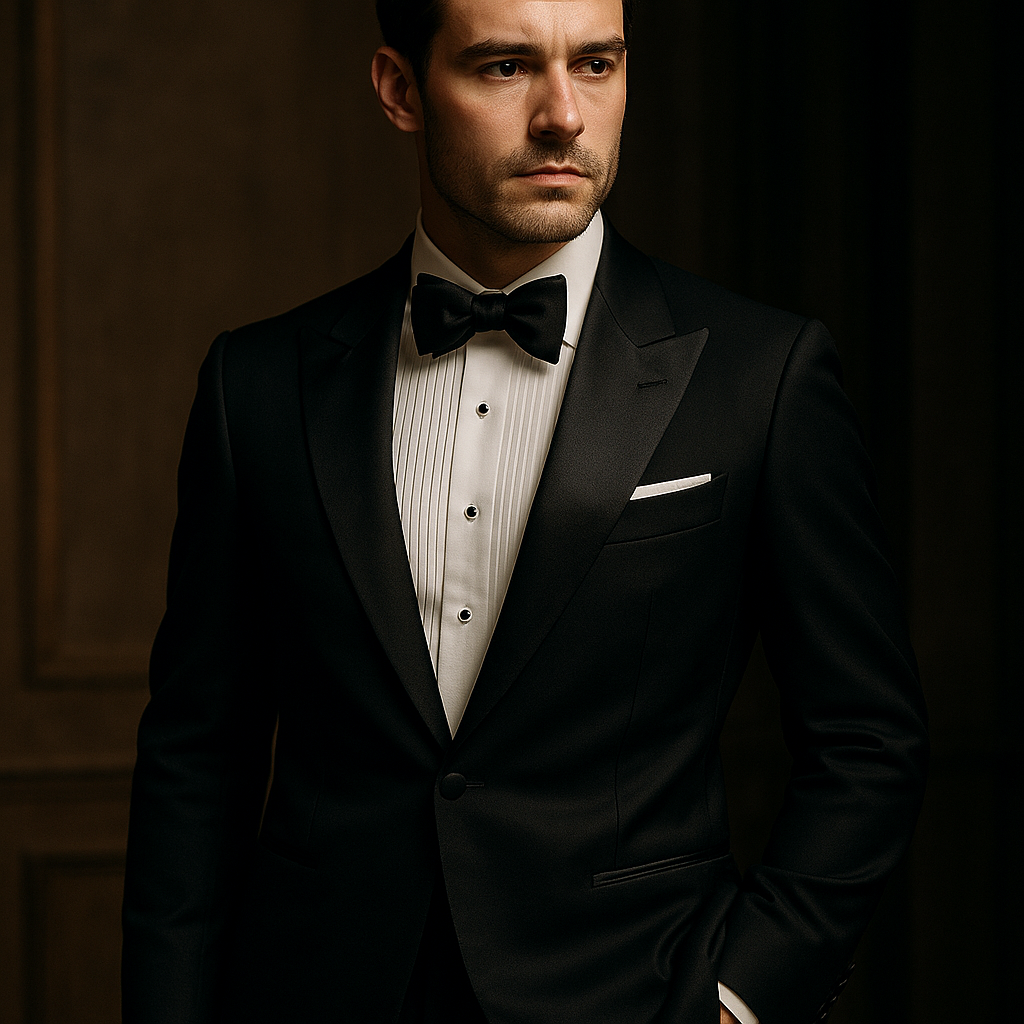
A tuxedo is the specific garment ensemble that fulfills black tie dress code requirements. The traditional tuxedo consists of a black or midnight blue wool dinner jacket with silk-faced lapels, matching trousers with a silk stripe down the outer seams, and a white formal shirt [2].
The jacket typically features a single button closure, jetted pockets, and either peaked or shawl lapels faced in silk grosgrain or satin [2]. While both lapel styles are equally correct, the shawl collar is considered slightly less formal.
The trousers are designed to sit at the natural waist without belt loops, traditionally supported by suspenders and featuring a single silk braid covering the outer seams [2]. This carefully coordinated combination of elements creates the refined minimalism that defines proper black tie attire [3].
Why These Terms Are Often Confused
The confusion between black tie and tuxedo stems from their close relationship - black tie is a dress code that requires wearing a tuxedo, which has led many to incorrectly label tuxedos as "black tie suits" [4]. Adding to this confusion are regional terminology differences between North America and Britain.
What Americans call a tuxedo, the British refer to as a dinner jacket or dinner suit [5]. This variation extends beyond just the garment name - formal wear terms can be contradictory on either side of the Atlantic, with many North Americans preferring original British terminologies over American derivatives [5].
For example, what's considered "formal" in North America is called "dress" in Britain, while "dress" in North America corresponds to "formal" in Britain [5]. This means a black tie event calls for a formal shirt in North America but a dress shirt in Britain, even though they refer to the same garment [5].
Regional Differences in Terminology (American vs. British 'Dinner Jacket') The terminology divide between American and British English reflects deeper cultural differences in formal wear traditions. In British English, what Americans call a tuxedo is referred to as a dinner suit or dinner jacket - terms that emerged from the garment's origins as evening attire worn specifically for dinner occasions [6]. The American term 'tuxedo' gained prominence around 1888, named after Tuxedo Park, an enclave for New York's social elite where the style became popular [6].
The British term 'dinner jacket' first appeared around 1887, while 'tuxedo' emerged in American usage by 1889 [6]. In modern British English, 'dinner jacket' is often simply abbreviated as 'DJ' [6]. The linguistic differences extend beyond just the garment name - what's considered 'formal' in North America corresponds to 'dress' in Britain, while 'dress' in North America aligns with 'formal' in Britain [6].
This variation means a black tie event requires a formal shirt in North America but a dress shirt in Britain, though they refer to the identical garment [6]. The term 'dinner jacket' remains distinctly British, stemming from the custom of these garments being worn in the evening around dinner time, dating back to when Henry Poole designed the first dinner jacket for the Prince of Wales in 1865 [6].

The Historical Evolution of Black Tie and the Tuxedo
Born in 1865 as the Prince of Wales's relaxed country-estate alternative to tailcoats, the tuxedo leapt from London's Savile Row to New York's Tuxedo Park in 1886 and rewrote evening-dress history.
Origins in Victorian England: How the First Tuxedo Came to Be
The modern tuxedo traces its origins to 1865, when the Prince of Wales (later King Edward VII) commissioned a tailless evening coat from Savile Row tailors Henry Poole & Co. The Prince wanted a more comfortable alternative to wear at informal dinner parties at his Sandringham country estate. The original design was a midnight blue silk smoking jacket with matching trousers [7].
This innovation spread through British high society as men sought alternatives to the formal evening tailcoat. By the 1880s, the "dinner jacket" had become established among the English upper classes as a less formal option for evening wear [8]. The jacket's introduction to America came in 1886 through James Brown Potter, a merchant banker who encountered the style while in London.
That same year, at Tuxedo Park - an exclusive enclave for New York's social elite - Griswold Lorillard and his friends caused a sensation by wearing these tailless dinner coats to the club's first Autumn Ball [8]. While initially controversial among American society, by 1888 the style had gained acceptance as appropriate summer and informal evening attire [7]. The term "tuxedo" derives from Tuxedo Park itself, while in British English it maintained the name "dinner jacket" - reflecting its origins as evening attire specifically for dinner occasions [8].
American Adoption and Evolution of Formal Evening Wear
The tuxedo's American journey began in 1886 when coffee tycoon James Brown Potter encountered the Prince of Wales, who advised Potter to have a dinner jacket made by his own tailors. Potter brought this novel garment back to share with fellow elites at Tuxedo Park, an exclusive New York social enclave [9].
While popular legend claims the tuxedo debuted dramatically at the Tuxedo Park's first Autumn Ball with young mavericks in tailless scarlet coats, historical records tell a different story. The actual American premiere was more subtle - Potter's colleagues wore their dinner jackets to Delmonico's restaurant in New York City, where other diners took notice and began associating the style with Tuxedo Park [9].
This connection led Americans to adopt 'tuxedo' as the garment's name, though the initial Town Topics report of 'tailless dress coats' referred to something quite different - military-style mess jackets cut at the waist, not the longer single-breasted dinner jackets we know today [9].
The Golden Age of Black Tie (1930s-1950s)
The period between the 1930s and 1950s marked the pinnacle of black tie formality and refinement. During this era, midnight blue emerged as a sophisticated alternative that rivaled black in popularity by the mid-1930s [3].
Double-breasted jackets gained acceptance, and white dinner jackets became a fashionable choice for warm weather occasions [3]. The traditional elements were firmly established - single-breasted jackets with silk-faced peaked or shawl lapels, matching trousers with silk braiding, and proper accessories like cummerbunds and waistcoats [3].
This period saw the standardization of many elements we now consider classic black tie, including the single silk stripe on trouser outseams becoming a universal feature by the 1930s [3]. While maintaining strict formal standards, the era allowed for tasteful experimentation within established boundaries - double-breasted models offered an elegant alternative to the classic single-breasted jacket, and warm weather variations like the white dinner jacket provided appropriate options for different climates and seasons [3].
Modern Interpretations and the Relaxing of Traditional Standards
Today's interpretation of formal dress codes differs significantly from historical standards. While Victorian and Edwardian eras maintained strict protocols for every social occasion, modern society has largely abandoned these rigid constraints - though not always to its benefit. This relaxation has led to widespread confusion about appropriate attire, with many viewing black tie requirements with unnecessary anxiety rather than appreciating their clarifying function [10].
The shift became particularly pronounced after World War II, when society began accepting business suits for evening events and elevated the dinner jacket to special occasion status. By the 1960s and 1970s, as casual wear entered offices and leisure suits became acceptable daywear, the traditional formal hierarchy shifted upward - making tuxedos formal attire and relegating tailcoats to near obsolescence [10]. In today's environment, where t-shirts appear in offices and sandals at theaters, 'formal' has become highly subjective, potentially meaning anything from a tuxedo to dark jeans with a black shirt.
Traditional dress codes now maintain relevance primarily at weddings, one of the last widespread formal occasions in middle-class society [10].
Essential Components of Proper Black Tie Attire
A proper black-tie outfit hinges on a single-button, ventless wool jacket with silk-faced lapels and matching-striped, suspender-held trousers--no belt loops, no cuffs, no flaps, just razor-sharp symmetry from lapel to seam.
The Tuxedo Jacket: Styles, Lapels, and Materials
A proper tuxedo jacket differs from regular suit jackets in several key ways. The most distinctive feature is the silk or satin facing on the lapels, which can be either peaked (most formal) or shawl style. The jacket should be black or midnight blue wool, with a single button closure and no vents for maximum formality.
Jetted pockets maintain clean lines without flaps. The lapel facings match the braiding on trouser seams and bow tie material, traditionally in either grosgrain or satin silk. Double-breasted models offer an elegant alternative while maintaining these core formal elements.
Modern interpretations sometimes include textural variations like velvet or subtle patterns, though these push the boundaries of traditional black tie. The jacket's cut should be trim but comfortable, allowing for a white formal shirt underneath without pulling at the closure. Proper fit means the jacket covers the seat while the sleeves show about 1/4 inch of shirt cuff.
Formal Trousers: The Satin Stripe Detail
The formal trousers worn with a tuxedo feature distinctive satin or grosgrain stripes running down the outer seams, a remnant of military dress from a bygone era [11]. These trousers should never have belt loops - proper tuxedo pants are designed to sit at the natural waist and are held up by suspenders (braces) [12]. The trousers can be either flat-fronted or pleated, with pleats first coming into fashion in the 1930s.
While flat-fronted trousers have become more fashionable recently, pleated versions may provide more comfort for men with wider hips and a narrow waist [3]. The outer seams are decorated with a single braid of silk or material matching the lapel facing, a detail that became standardized by the 1930s [3]. Traditional black tie trousers also eschew turn-ups (cuffs) to maintain clean lines [12].
The trousers' refined minimalism is further enhanced by the absence of flap pockets, which would disrupt the sleek silhouette essential to formal wear [11].
The Dress Shirt: Wing Collar vs. Turndown Collar
The choice between wing and turndown collars reflects a complex evolution in formal shirt styles. While many assume wing collars are essential for black tie, the turndown collar actually became the true black-tie standard after World War II. The wing collar originated with the tailcoat, featuring a stiff, detachable design meant for white tie events.
During the interwar period, the turndown collar emerged as a more relaxed option that better suited the tuxedo's semi-formal nature, offering a softer front and more practical laundering [13]. The 1970s introduced a hybrid shirt that muddied these distinctions - an attached wing collar that initially mimicked the aristocratic original's bold proportions but devolved into diminished dimensions by the 1980s. While British formal wear enthusiasts rejected this compromise, it gained surprising popularity in mainstream American fashion.
However, America's political and social elite maintained their preference for the understated turndown collar, creating a clear distinction that persists today between those who understand traditional standards and those who don't [13].
Critical Accessories: Bow Ties, Cummerbunds, and Proper Footwear
The bow tie stands as the defining accessory of black tie attire, traditionally matched to the lapel facings in either satin or grosgrain silk. A proper bow tie should always be hand-tied rather than pre-tied, as rental-style clip-ons immediately signal inexperience with formal wear [14]. The cummerbund serves both practical and aesthetic purposes, covering the waistband while creating a pleasing visual line that makes the torso appear slimmer.
It should be worn with pleats facing upward, sitting at the natural waist above the trouser waistband [15]. The fabric should match the bow tie and lapel facings, typically in black silk satin, grosgrain, or barathea. For footwear, black patent leather oxfords without toe caps represent the most formal and traditional choice, paired with black evening socks that extend high enough to prevent any skin exposure when seated [14].
The complete ensemble requires shirt studs and cufflinks in matching metals, while a white linen pocket square provides the finishing touch without attempting to match other accessories [14].
Black Tie Variations and Flexibility
Master the unbreakable rules of black-tie--black or midnight wool, silk-faced lapels, single button, no vents, matching braid-trimmed trousers, white pleated shirt, hand-tied bow tie, waistcoat or cummerbund (never both), patent opera pumps--and reserve the ivory dinner jacket strictly for after-six tropical evenings, never in Britain or big cities.
Traditional Black Tie: The Classic Standard
The classic black tie ensemble represents the gold standard of formal evening attire, with specific requirements that have evolved since its Victorian origins. The traditional dinner jacket should be black or midnight blue worsted wool, featuring silk-faced peaked or shawl lapels, with a single button closure and no vents for maximum formality [16].
The jacket must be paired with matching trousers featuring a single silk braid covering the outer seams, designed to sit at the natural waist without belt loops and supported by suspenders [16]. A proper formal shirt should be white with either a pleated or marcella bib front, accompanied by a hand-tied black bow tie that matches the lapel facing material [3].
The ensemble requires either a low-cut waistcoat or cummerbund as a waist covering - but never both simultaneously - with the traditional color being black to maintain the refined minimalism of the outfit [16]. Footwear follows strict guidelines: patent leather opera pumps with grosgrain bows represent the most formal option, though plain-toe black oxford shoes in either patent or polished calfskin are equally acceptable [16].
Warm Weather Black Tie: White Dinner Jackets and Summer Options
The white dinner jacket offers an elegant warm-weather alternative to traditional black tie attire. While commonly called 'white,' these jackets are typically ivory or off-white due to natural fiber limitations that prevent pure white coloring [18]. The jacket follows core black tie conventions with one button for single-breasted or multiple buttons for double-breasted versions, though it traditionally lacks the silk facings found on black dinner jackets [18].
Proper wear requires black or midnight blue trousers, a white formal shirt, and a black bow tie that matches the trouser stripe [18]. This ensemble is strictly for evening events after 6 PM, despite its lighter color [18]. Location and climate dictate appropriateness - white dinner jackets should never be worn in the British Isles or large cities, and are best suited for tropical regions, outdoor summer events, and cruise ships [17].
The jacket pairs well with black patent leather oxfords or pumps, while a black cummerbund or backless waistcoat can provide waist coverage suitable for warm weather [18]. For less formal occasions, the ensemble allows some flexibility - a plain voile shirt can replace pleated versions in extreme heat, though wing collars and shirt studs should be avoided as they appear overly formal with this more relaxed variation of black tie [18].
Creative Black Tie: Acceptable Personalization
Creative black tie offers opportunities for personal expression while maintaining formal foundations. The key is keeping deviations subdued and nuanced - never distracting from the overall elegance. Color provides the simplest customization path but requires careful restraint to avoid degrading the tuxedo into a prom costume [19].
Metallic accents, particularly in deep silver, can tastefully bridge traditional formality with modern style, though they're best limited to cummerbunds or waistcoats that sit just above the jacket opening [19]. Pattern is acceptable primarily in accessories, provided designs remain subtle and predominantly black and white. A black velvet dinner jacket offers perhaps the most sophisticated personalization, combining smoking jacket luxury with classic tuxedo styling [19].
For neckwear, subtle patterns on black bow ties maintain formality while adding character, though prominent designs or colors should be avoided as they detract from the face - the intended focal point of refined attire [19]. The black cashmere turtleneck presents an elegant creative alternative, replacing traditional shirt, tie and waist covering with luxurious simplicity [19]. This calculated break from convention succeeds by substituting multiple formal elements with an uninterrupted expanse of premium fabric [19].
Contemporary Interpretations for Modern Events
Modern black tie continues evolving while maintaining its core elegance. Today's interpretations allow more room for personal style and creativity without compromising formality. For formal occasions, midnight blue tuxedos, rich velvet dinner jackets, and sharp tailored silhouettes define the contemporary landscape [20].
Creative black tie offers opportunities for thoughtful personalization through deep jewel tones, subtle patterns, and textural variations like velvet - though these elements should enhance rather than overshadow the ensemble's refinement [20]. The dress code has adapted to different settings and themes while preserving its signature sophistication. For less rigid events, options like burgundy or velvet tuxedos provide stylish alternatives to traditional black, though any deviation should maintain the polished minimalism that defines proper black tie [20].
Context remains crucial - digital invitations often signal a more relaxed interpretation compared to formal card stock invitations with wax seals, though exceptions exist for platforms like Paperless Post [21]. When uncertain about formality level, consulting the host about their vision helps ensure appropriate attire that respects the occasion while allowing for measured personal expression [21].


Common Mistakes and How to Avoid Them
Wearing a black suit instead of a tuxedo--missing its tell-tale satin lapels, buttons and trouser stripes--will leave you underdressed at any true black-tie affair, while the right white shirt with French cuffs and a turndown collar quietly signals you know the rules.
Substituting a Regular Suit for a Tuxedo
Substituting a regular black suit for a tuxedo at formal events is one of the most common dress code mistakes. While both garments share a similar structure of jacket and trousers, the key distinguishing feature is satin detailing - tuxedos incorporate satin-faced lapels, satin buttons, and satin stripes down trouser legs, while suits lack these formal embellishments [22].
For white tie and black tie events, a black suit is never an appropriate substitute for a proper tuxedo, regardless of how formal the suit appears [22]. The formality distinction matters - tuxedos are reserved specifically for the most formal evening occasions, while suits offer more versatility across different dress codes and times of day [22].
Even an impeccably tailored black suit will appear underdressed at a true black tie event where tuxedos are required. The only time a dark suit becomes an acceptable alternative is for 'black tie optional' events, where suits styled formally can appropriately substitute for tuxedo wear [22].
Improper Shirt Choices (Pleats, Collars, and Closures)
Proper formal shirt selection requires careful attention to several key details. The shirt must be plain white with either a pleated or marcella bib front, accompanied by double (French) cuffs designed for cufflinks [13]. While many assume wing collars are essential, the turndown collar actually became the true black-tie standard after World War II.
Wing collars originated with tailcoats and were meant for white tie events, featuring a stiff, detachable design [13]. The 1970s introduced a hybrid shirt with an attached wing collar that initially mimicked the aristocratic original's bold proportions but devolved into diminished dimensions by the 1980s. While British formal wear enthusiasts rejected this compromise, it gained surprising popularity in mainstream American fashion.
However, America's political and social elite maintained their preference for the understated turndown collar, creating a clear distinction between those who understand traditional standards and those who don't [13]. The shirt should include small loops that button to the inside of the trousers to keep them properly tucked, while the bottom should always be covered by the cummerbund or waistcoat [13].
Accessory Errors (Pre-tied Bow Ties, Wrong Footwear)
Accessory errors can quickly undermine an otherwise proper black tie ensemble. Pre-tied bow ties are an immediate giveaway - their artificially perfect symmetry lacks the authentic character of a hand-tied bow. While pre-tied options may seem convenient, they appear stiff and manufactured compared to the subtle asymmetry that gives hand-tied bows their sophisticated charm [23].
Footwear mistakes are equally detrimental to the overall look. Many men incorrectly assume any black dress shoe will suffice, but proper black tie footwear requires either black patent leather oxfords without toe caps or formal opera pumps. Avoid casual details like wingtips or broguing, and never wear derbies, which are too informal for black tie events [24].
The shoes should be paired with black silk evening socks that prevent skin exposure when seated, while evening shoelaces should match the bow tie, cummerbund, and lapel facings in material and finish [23].
Fit Issues That Undermine Your Formal Look
A proper fitting tuxedo starts with the collar, which should hug your neck without gaps or rolling in the back - any space between jacket and shirt collar appears sloppy and undermines the entire look [25]. The shoulders must follow your natural body line, ending precisely where your arm begins, as shoulders extending beyond this point create an oversized appearance while tight shoulders cause unsightly wrinkling [25]. The jacket's midsection requires precise button placement at the narrowest part of your torso to create an elegant taper without pulling or bunching [25].
For proper sleeve fit, the sleeve head should fall smoothly where it meets the shoulder seam, allowing about a quarter to half-inch of shirt cuff to show [25]. The jacket length should hit around the crotch level for single-breasted styles, while double-breasted jackets can be slightly longer to maintain proper proportions [25]. The trousers must sit at the natural waist without belt loops, traditionally held up by suspenders, as proper tuxedo pants eschew belt loops to maintain clean lines [26].
The refined minimalism of formal trousers is further enhanced by the absence of flap pockets and turn-ups which would disrupt the sleek formal silhouette [26].


Navigating Black Tie Events: Practical Advice
Decode the dress-code hieroglyphics on every invitation--from white-tie tails to cocktail separates--and do the quick math on rent-vs-buy so you'll look flawless without overpaying for a one-night tux.
Decoding Invitation Wording: What Different Terms Mean
Understanding invitation wording helps ensure appropriate attire for formal events. When an invitation specifies 'white tie,' it indicates the most formal dress code possible, requiring floor-length evening gowns for women and tuxedos with tails for men [27]. 'Black tie' signals a formal evening event where women should wear floor-length gowns or sophisticated cocktail dresses, while men must wear tuxedos with black bow ties [27].
'Black tie optional' or 'formal' gives guests more flexibility - men can choose between a tuxedo or dark formal suit, while women can opt for formal evening gowns, cocktail dresses, or dressy separates [27]. For 'cocktail attire,' women should select tea-length, knee-length or midi dresses rather than floor-length gowns, while men wear suits with ties [27]. 'Semi-formal' or 'dressy casual' varies based on time of day - darker colors work best for evening events, while lighter hues suit daytime occasions [27].
When no dress code is specified, guests should consider context clues like venue, time of day, season and formality of the invitation - generally, a knee-length cocktail dress for women or dark suit for men is appropriate [27].
Rental vs. Purchase: Making the Right Decision
The decision between renting and buying a tuxedo depends on several key factors. Rental costs typically range from $100-250, including jacket, pants, shirt, vest/cummerbund, and bow tie, while purchasing a quality tuxedo requires $300-800 for basic styles and an additional $150-300 for accessories [28]. Renting offers distinct advantages for single events - providing access to current styles without storage concerns and professional fitting services to ensure proper fit [29].
However, purchasing becomes more economical when attending multiple formal events within a year, with the added benefit of unlimited alterations to achieve and maintain a perfect fit over time [30]. For those with unique sizing needs, especially in big and tall ranges, purchasing provides significantly more options than standard rental sizes [30]. The rental process has become streamlined through online platforms that use advanced fitting techniques and algorithms to ensure proper fit, while dispelling common myths about inferior materials or complicated processes [29].
The choice ultimately hinges on event frequency, body type, and style preferences - renting suits occasional formal events while purchasing serves those who regularly attend black-tie functions or require specific alterations [28].
Essential Alterations for a Perfect Fit
A properly tailored tuxedo requires several key alterations to achieve the perfect formal look. The jacket demands precise adjustments - the collar must hug your neck without gaps or rolling, while shoulders should follow your natural body line and end exactly where your arm begins [31].
The midsection requires strategic button placement at the narrowest part of your torso to create an elegant taper, and sleeve heads must fall smoothly at the shoulder seam while allowing 1/4 to 1/2 inch of shirt cuff to show [31]. For trousers, proper alterations ensure they sit naturally at the waist without belt loops, traditionally supported by suspenders to maintain clean lines [31].
Most off-the-rack tuxedos require basic alterations like hemming unfinished pant lengths, adjusting jacket fit through the waist, and modifying sleeve lengths to achieve that sharp, custom-tailored appearance [32]. While alteration costs vary by complexity and location, they represent an essential investment in achieving the refined minimalism that defines proper black tie attire [32].
Building a Versatile Formal Wardrobe
starts with investing in core black tie pieces that offer maximum flexibility. A classic black or midnight blue tuxedo with satin-faced peaked or shawl lapels serves as the foundation, ideally in barathea wool for its elegant drape and matte appearance [33]. For the dress shirt collection, include both pleated and pique bib options - pleated for traditional events and pique for modern interpretations, ensuring all feature French cuffs for cufflink versatility [34].
Multiple bow tie options allow adaptation to different formality levels - a classic black silk butterfly for strict black tie, and perhaps a subtle pattern or deep jewel tone for creative black tie events [34]. The trouser selection should include both flat-front and pleated styles in matching jacket fabrics, all featuring the signature satin stripe [33]. For footwear, invest in both patent leather oxfords for peak formality and polished calfskin for slightly relaxed occasions [35].
Complete the collection with refined accessories like brass or mother of pearl cufflinks, a black silk cummerbund, and crisp white pocket squares that maintain versatility across all formal occasions [33].
- Black tie is a dress code, not a garment; a tuxedo is the required outfit.
- Tuxedo jackets must have silk-faced lapels, single button, no vents, and jetted pockets.
- Trousers need a satin stripe, no belt loops, and should be worn with suspenders.
- Turndown collar shirts replaced wing collars as the post-WWII black-tie standard.
- Hand-tied bow ties, patent leather oxfords, and a cummerbund are essential accessories.
- White dinner jackets are ivory, paired with black trousers, for warm climates only.
- A black suit lacks satin trim and is never acceptable for true black-tie events.
- https://emilypost.com/advice/black-tie-dress-code
- https://www.artofmanliness.com/style/clothing/black-tie-how-to-wear-tuxedo/
- https://en.wikipedia.org/wiki/Black_tie
- https://www.ferrariformal.com.au/black-tie-vs-tuxedo/
- https://www.gentlemansgazette.com/tuxedo-black-tie-guide/introduction/tuxedo-dinner-jacket-smoking/
- https://www.theknot.com/content/dinner-jacket
- https://www.gentlemansgazette.com/tuxedo-black-tie-guide/black-tie-tuxedo-history/dinner-jacket-debut/
- https://emilypost.com/advice/the-origin-of-the-tuxedo
- https://mytuxedocatalog.com/blog/125th-anniversary-of-the-tuxedo-part-i-origins/
- https://www.gentlemansgazette.com/tuxedo-black-tie-guide/etiquette/why-black-tie-matters/
- https://www.paulsmith.com/discover/tuxedo-black-tie-dress-code-guide
- https://blacklapel.com/thecompass/black-tie-101-how-to-look-great-in-a-tuxedo/?srsltid=AfmBOop5BYE6nukSurx4oFZKKJYWLupGZgKfUOCPEL3ITlfjh7Ho1nsP
- https://www.gentlemansgazette.com/tale-of-two-collars/
- https://www.beaumontetiquette.com/post/the-etiquette-guide-for-black-tie-dress-code
- https://www.gentlemansgazette.com/cummerbund-definitive-guide/
- https://www.gentlemansgazette.com/tuxedo-black-tie-guide/
- https://westwoodhart.com/blogs/westwood-hart/formal-wear-etiquette-black-tie-white-tuxedo-guide?srsltid=AfmBOoqi_rZUl0JsmaGa0vACoXQZPsiS4TU_Sqa45s-Vzg2LQNyOjRRk
- https://www.bondsuits.com/james-bonds-warm-weather-black-tie-etiquette/
- https://www.gentlemansgazette.com/tuxedo-black-tie-guide/contemporary/contemporary-tuxedo-alternatives-personalization/
- https://hangrr.com/resources/ultimate-black-tie-guide?srsltid=AfmBOorVlm-C_3FgeR6UPSJza3wPlhzgKovfG8XJ6YMWVpobK6C8OuKP
- https://www.vogue.com/article/black-tie-dress-code
- https://www.theknot.com/content/tuxedo-vs-suit
- https://www.gentlemansgazette.com/black-tie-tuxedo-mistakes/
- https://www.realmenrealstyle.com/black-tie-attire-mistakes/
- https://articlesofstyle.com/blogs/news/ultimate-tuxedo-fit-guide?srsltid=AfmBOorNzT9WyLCplLc3PJOfc_MqUJ2qsGc1jYDI-2nHS3r5H-bAEgsv
- https://blog.lanieri.com/en/the-tuxedo-dos-and-donts/
- https://www.brides.com/story/wedding-dress-code-explained
- https://www.menswearhouse.com/blog/weddings/rent-or-buy-tuxedo/?srsltid=AfmBOoq4gQdebN0duVNJSlkGexzfVvkeU0rJcJQzn-qI1q2PcsKb5Wb0
- https://generationtux.com/blog/wedding-planning/rent-vs-buy-tuxedo
- https://onoreclothing.com/style-guide/renting-vs-buying-your-suit-or-tuxedo
- https://www.tailoronten.com/blogs/news/16103104-the-essential-black-tie-guide
- https://perfecttux.com/blogs/news/suit-tuxedo-alterations-what-you-need-to-know
- https://www.gq.com/story/black-tie-attire-explained
- https://hangrr.com/resources/ultimate-black-tie-guide?srsltid=AfmBOop7R1pmH9hqcrjG8fDD6Eq8zzUahWzMg3ze3hzTjckfemHvDeVI
- https://www.otaa.com/blogs/journal/what-to-wear-for-a-black-tie-event


