



What Is Cocktail Attire? An Essential Men's Dress Code Guide
Master cocktail attire by balancing a dark tailored suit with subtle accessories and season-right fabrics. You'll move from ceremony to celebration looking polished never overdressed.
Understanding Cocktail Attire
Cocktail attire sits perfectly between business casual and black tie, giving you creative flexibility while maintaining a polished, put-together appearance.
What is cocktail attire? Definition and key elements
Cocktail attire is a semi-formal dress code positioned between business casual and black tie -- more polished than everyday office wear, but less formal than a tuxedo [1]. For men, the defining elements are a dark suit in navy or charcoal, a dress shirt, neckwear, and leather dress shoes [1].
It gives you more creative flexibility than a strict formal code while still maintaining a cohesive, put-together look [2]. The dress code developed in early 20th-century social culture, when a gap between daytime and evening wear created demand for something in between -- a function it still serves today [1].
Where cocktail attire sits on the formality spectrum
The spectrum runs from casual to white tie, and cocktail attire lands squarely in the middle -- on par with business attire but clearly below black tie optional and formal evening wear. [3] Within that range, there's real flexibility: one cocktail outfit might sit just a step above business casual, while another could pass for near-formal at first glance. [1] Jeans, polo shirts, and loafers fall below the threshold; tuxedo jackets, cummerbunds, and formal waistcoats exceed it. [1] Knowing where those edges are makes it easier to dress confidently for any invitation that uses this code.
Typical events that call for cocktail attire for men
Cocktail attire shows up most on invitations for weddings, galas, corporate dinners, retirement parties, and receptions -- any event where hosts want a polished room without going full black tie. [1] The event context tells you how formal to skew within that range: a church wedding with a hotel reception calls for a darker, conservative suit, while a summer networking event or outdoor reception gives you more room to experiment with lighter fabrics and softer tones. [4] For tips on wedding outfits for men across different venue types, time of day and setting are your two clearest signals.
Worth noting: a cocktail party invitation doesn't automatically mean cocktail attire is the required dress code, so always check whether the host has specified one before building your look. [1]

Building the Perfect Cocktail Outfit
Match your belt to your shoes in both finish and tone to signal intentional style that elevates your entire cocktail look.
Suit and blazer choices: colors, fabrics, and modern fits
For a classic cocktail look, start with a dark suit in navy, charcoal, or black -- these read polished without crossing into tuxedo territory. [4] If you want to move beyond basic office wear, try bolder tones like burgundy or deep green, or add visual interest through patterns like windowpane checks, pinstripes, or houndstooth. [5] Fabric matters as much as color: wool outperforms polyester for most events, while linen or seersucker works well for summer receptions, and velvet or corduroy adds texture for evening occasions. [5] A full suit isn't required -- a well-matched blazer and trouser combination works just as well, as long as both pieces look intentional together rather than pulled from separate outfits. [5]
Shirt, tie, and pocket‑square coordination for a polished look
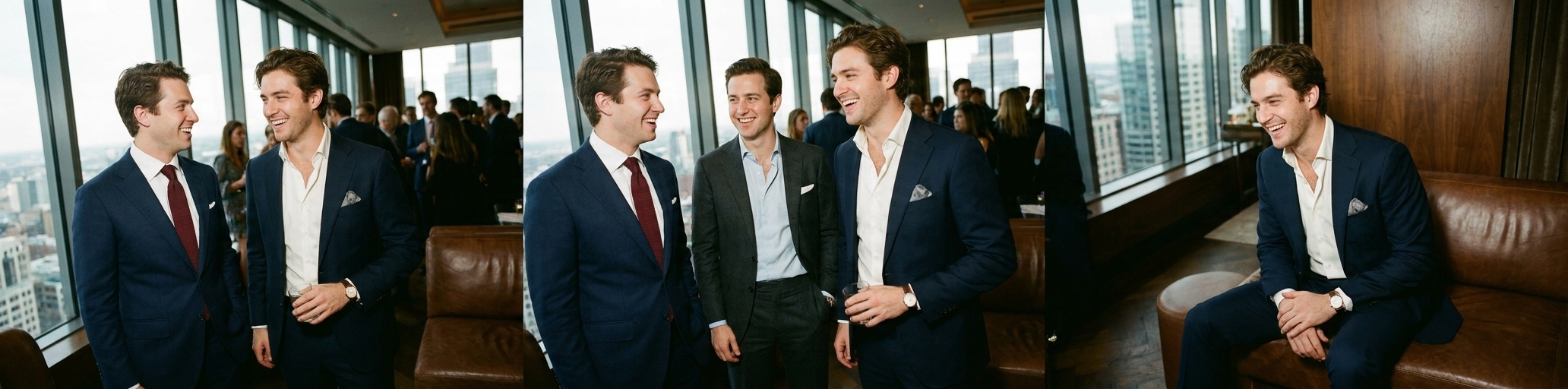
For the shirt, white and light pastels -- blue, lavender, or pink -- are the most versatile base because they let your tie and pocket square carry the visual weight. [6] Silk ties in solid colors, stripes, or understated prints like paisley or geometric patterns work well for cocktail events; if you skip the tie, a pocket square becomes more critical to maintaining a polished look. [6] The core rule for pocket square coordination is to complement rather than exactly match your tie -- use the same color family in a noticeably different shade, or pick a color that sits adjacent on the color wheel. [7] When mixing patterns, vary the scale: pair a large-pattern tie with a small-scale pocket square so both elements harmonize rather than compete. [7]
Footwear and accessories: shoes, belts, watches, and subtle details
Shoes anchor the look: dark leather is the standard, with a black Oxford as the safest choice and a derby or monk strap if you want something slightly more distinctive without overdoing it. [1] Whatever style you choose, match your belt to your shoes in both finish and tone -- this single coordination detail signals care in a way that's easy to miss but impossible to ignore when it's done well. [1] Beyond that, two or three accessories are enough: a quality watch, cufflinks if your shirt has French cuffs, and socks that pull a color from somewhere else in the outfit. [5] Layering more than that -- or leaning on pieces with heavy logos -- tends to pull the look away from polished and toward overdressed. [4]


Adapting to Event Types and Seasons
Lighter suit tones and breathable fabrics work best for daytime events, while evening occasions call for darker palettes and heavier materials that hold visual weight under artificial light.
Daytime vs. evening: seasonal fabric swaps and color tones
The split between daytime and evening cocktail events comes down to color depth and fabric weight.
For daytime events -- typically anything before 5 p.m. -- lighter suit tones are appropriate: medium blues, earthy greens, and warm browns all read polished without feeling overly conservative.[1] If you're dressing for a warm-weather or outdoor summer event, linen or seersucker in a dark navy works well in place of heavier wool, keeping you comfortable without sacrificing the dressed-up feel.[4] Evening events call for darker, quieter palettes -- charcoal, deep navy, and jewel tones hold up better under artificial light, and heavier fabrics like wool or velvet bring the right visual weight to a night setting.[1]
Business cocktail events versus wedding cocktail attire
The same dress code reads differently depending on whether you're walking into a corporate reception or a wedding. Business cocktail events call for a more conservative approach -- darker suits, subdued accessories, and nothing that creates a flashy impression among professional contacts [1].
Wedding cocktail attire gives you slightly more room to experiment with color and pattern, but the constraint is different: the couple should be the visual focus, so bold prints or attention-grabbing accessories aren't the right call [1]. For more on balancing the couple's style with your own, let the venue and time of day guide how formal or relaxed you go -- a hotel ballroom evening wedding reads very differently than an afternoon garden reception [8].
Casual cocktail twists: when a tie is optional and sport‑coat styling
When the event leans more relaxed -- a company cocktail hour, a rehearsal dinner, or a casual summer reception -- skipping the tie is acceptable as long as the rest of the outfit compensates. [9] A sport coat with contrasting trousers works well here: try a textured hopsack or windowpane-check blazer with solid dress pants, which creates enough visual structure without a full matching suit. [9] When you drop the tie, shift visual interest elsewhere -- a pocket square becomes essential, and a subtle trouser pattern or a well-structured collar can fill the gap left by missing neckwear. [10] The sport coat route works best when both pieces look intentional together, not like separates pulled from different outfits. [10]
- Cocktail attire = dark tailored suit, collared shirt, leather shoes; optional tie/pocket square
- Navy/charcoal suits photograph well; lighter greys only for daytime/summer events
- Fit is critical: half-inch shirt cuff showing, jacket buttons without pulling, slight trouser break
- Evening events need darker colors and finer fabrics; daytime allows lighter tones and textures
- Skip tie only if shirt has structured collar and pocket square maintains polished look
- Match leather belt to shoes; over-the-calf socks mandatory; keep accessories minimal
- https://www.gentlemansgazette.com/cocktail-attire-for-men/
- https://www.zola.com/expert-advice/cocktail-attire-for-men-a-comprehensive-guide
- https://emilypost.com/advice/attire-guide-dress-codes-from-casual-to-white-tie
- https://www.gq.com/story/cocktail-attire-for-men
- https://www.apetogentleman.com/cocktail-attire-for-men/
- https://thedarkknot.com/blogs/suitupdressup/mastering-men-s-cocktail-attire-a-complete-guide-to-cocktail-attire-for-men?srsltid=AfmBOooEQtImd9V7wbiJBs95q-v1d3DJU40MVVrLuBCcvWI2A0GVfxio
- https://www.thetiebar.com/blogs/news/how-to-match-ties-pocket-squares-a-complete-guide?srsltid=AfmBOoq8JB3yfLdID6oOlTDIG7WJsR4Y9Asav4r0VNgGYUmZM2LFiXWI
- https://www.theknot.com/content/cocktail-wedding-attire
- https://www.vogue.com/article/cocktail-attire-for-men-fashion-guide
- https://www.primermagazine.com/2023/learn/blazer-no-tie


